Observation-space similarity misses model uncertainty.
Static-looking frames can still demand a fresh forward pass when the action distribution narrows or shifts at grasp and alignment steps.
Neural introspection for real-time robotics
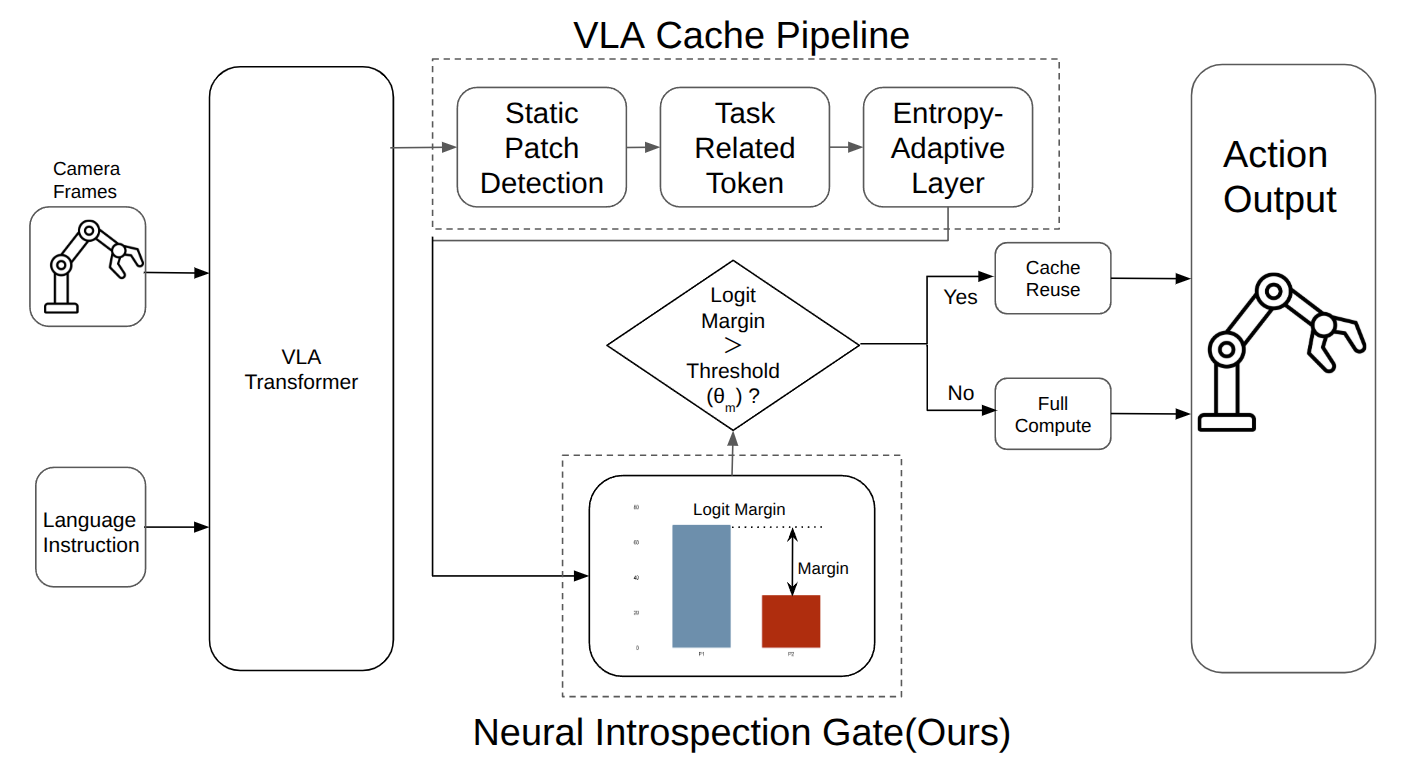
This work keeps the cache when the model is confident and invalidates it when the action distribution becomes uncertain, using a zero-cost logit-margin signal extracted during decoding.
Reuse is trusted only when the model stays decisively ahead of its second-best action token.
Recovers the accuracy lost by blind caching on the hardest benchmark split.
Stays well below full inference while avoiding stale cache reuse at critical moments.
The gate preserves the savings of VLA-Cache when frames are redundant and pays the recompute cost only when the model itself is unsure.
Static-looking frames can still demand a fresh forward pass when the action distribution narrows or shifts at grasp and alignment steps.
The cache is invalidated when the average gap between the best and second-best action tokens falls below a threshold.
On LIBERO-Goal and LIBERO-Long, the gated variant restores the lost accuracy while retaining most of the compute savings.
Abstract
Vision-Language-Action models map camera images and language instructions directly to motor commands with a single autoregressive transformer. In real-time control, however, they still spend substantial compute recomputing KV states. This paper extends VLA-Cache with a training-free neural introspection gate that monitors the mean top-1/top-2 logit margin during decoding. When the margin falls below a threshold, the cache is invalidated and the model performs a full recompute; otherwise, the standard patch-similarity and layer-wise reuse pipeline proceeds.
Evaluated on the LIBERO benchmark suite with OpenVLA and OpenVLA-OFT, the gated method improves reliability whenever blind caching hurts. On LIBERO-Goal and LIBERO-Long, it recovers the accuracy lost by VLA-Cache while keeping most of the compute savings, and it remains safe when caching is already stable.
Method
Consecutive images are compared patch-by-patch. Similar patches become candidates for KV reuse.
Patches with strong text-to-vision attention are excluded so semantically important regions are recomputed.
Each transformer layer reuses a different share of tokens based on its attention entropy.
If the model's average top-1/top-2 margin drops below threshold, the entire cache is discarded and recomputed from scratch.
The gate is zero-cost at inference time because it uses the logits already produced by the decoder.
Results
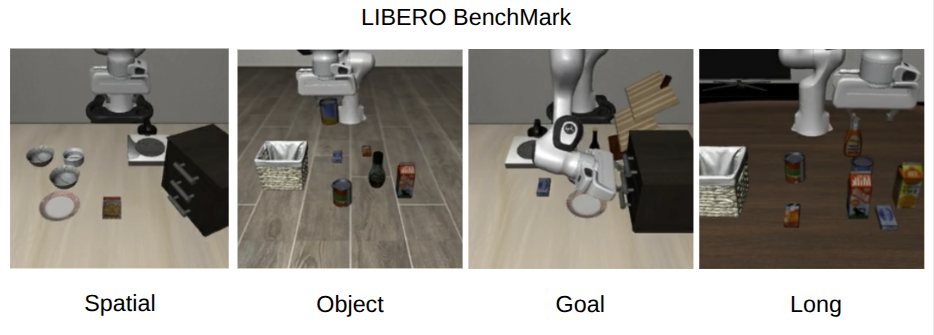
Gating rescues the benchmark where blind caching loses accuracy on the long-horizon suite.
Numbers shown as Success rate (%) / TFLOPs
| Task | Full | VLA-Cache | Ours |
|---|---|---|---|
| Spatial | 78.8 / 1.89 | 78.8 / 1.43 | 79.4 / 1.55 |
| Object | 70.4 / 1.86 | 69.4 / 1.44 | 67.8 / 1.54 |
| Goal | 77.2 / 1.83 | 74.0 / 1.40 | 77.4 / 1.50 |
| Long | 54.0 / 1.88 | 50.2 / 1.43 | 54.8 / 1.54 |
| Avg. | 70.1 / 1.87 | 68.1 / 1.43 | 69.9 / 1.53 |
When caching is already stable, the gate keeps performance on par with the baselines and adds little overhead.
Numbers shown as Success rate (%) / TFLOPs
| Task | Full | VLA-Cache | Ours |
|---|---|---|---|
| Spatial | 93.8 / 4.00 | 93.8 / 3.11 | 94.0 / 3.23 |
| Object | 98.4 / 3.96 | 98.6 / 3.05 | 98.6 / 3.08 |
| Goal | 97.2 / 3.94 | 96.8 / 3.06 | 97.0 / 3.07 |
| Long | 93.8 / 3.98 | 94.0 / 3.05 | 93.0 / 3.13 |
| Avg. | 95.8 / 3.97 | 95.8 / 3.07 | 95.7 / 3.13 |
Citation
@article{wu2026neuralintrospection,
  title   = {Neural Introspection Gating for Adaptive KV-Cache Reuse in Vision-Language-Action Models},
  author  = {Wu, Zhijie and Kawaharazuka, Kento and Okada, Kei},
  year    = {2026},
  eprint  = {2608.10824},
  archivePrefix = {arXiv}
}